
Tsintaosaurus
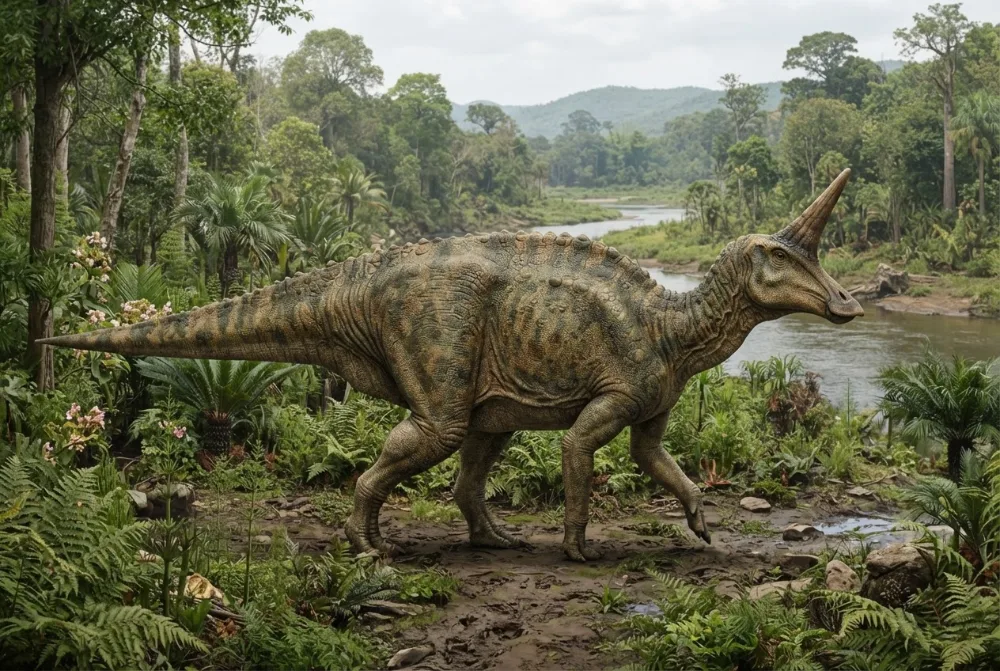
Tsintaosaurus was a duck-billed dinosaur that lived in China during the Late Cretaceous. It had a strange, hollow crest on its head that looked a bit like a unicorn horn. This plant-eater could walk on four legs or run on two to escape predators.21
Ɗuum wuurii nde?
Hol no o mawni?
No juutuno?
No toowuno?
No tedduno?
Hol no Tsintaosaurus mawninoo, so fondaama bee AAN?
Hiisa tan nder browser maa. Walaa huunde danndetee walla neldetee ka nokku fuu.
How fast was it?
Anndal belɗungal
Tsintaosaurus was first thought to have a unicorn-like horn, but scientists now think the crest was actually part of a larger, hollow structure on its snout.2
The crest was hollow and may have been used to make loud honking sounds to communicate with other Tsintaosaurus.2
It lived about 84 to 71 million years ago, during the Campanian stage of the Late Cretaceous.1
Tsintaosaurus is known from skulls and a partial skeleton, so scientists are still learning about its body.1
Like other hadrosaurs, Tsintaosaurus probably traveled in herds for protection.2
The name Tsintaosaurus comes from the old spelling of Qingdao, the city near where it was found.2
Naamne ɓurɗe naamneede fii Tsintaosaurus
?How big was Tsintaosaurus?
About 8.3 metres (27 feet) long and weighed 2.5 tonnes (2.8 short tons), according to Wikipedia. The Natural History Museum gives a length of 12.0 metres, so estimates vary.21
?What did Tsintaosaurus eat?
It was a plant-eater. It had a duck-like beak and strong teeth for chewing vegetation.21
?Why did Tsintaosaurus have a crest?
The crest was hollow and may have been used to make loud honking sounds to communicate. It might also have helped attract mates, and the hollow tube made the crest lighter.24
?Could Tsintaosaurus swim?
It had a large tail that may have helped it swim, according to the Australian Museum. It probably lived near lakes and rivers.4
Naamnu Rex fii Tsintaosaurus
Rex jaabata ƴamle dow hello ngo'o tan. Ƴamle 10 e lewru.
Rex ko AI, o waawi waɗugo juumre. O golla ka serverji nder EU, naamne danndetaake abada. Taa winndu innde maa walla huunde goɗnde ngam maa.
Feññinoowo goonga
Fenaande: Tsintaosaurus had a single, solid horn like a unicorn.
Goonga: The crest was actually hollow and was the back part of a larger, flat crest that ran from the tip of the snout.2
Ngam annduɓe dino
- Innde ganndal
- Tsintaosaurus
- Inndoowo
- Young 19585
- Fedde
- Hunduko yaajuko
- Fedde / clade
- Hadrosauridae5
- Fedde
- Ornithischia > Ornithopoda > Iguanodontia > Hadrosauridae5
- Duuɓi kaaƴe
- 84 haa 72 miliyon duuɓi (Campanian)5
- Cuuɗi kaaƴe
- Jingangkou5
- Leyɗe
- China5
- Fosilji tawaaɗi
- 4 nder Paleobiology Database5
- Tawgol
- Chinese paleontologist C. C. Young named Tsintaosaurus in 1958 after fossils were found near Laiyang, Shandong, China.21
- Haa jooni ɓe ɗon yeddondira
- Scientists still debate the exact shape and function of Tsintaosaurus's head crest, because only a few fossils have been found.2
To haalaaji ummii
- Tsintaosaurus | Natural History Museum (nhm.ac.uk)
- Tsintaosaurus (en.wikipedia.org)
- Tsintaosaurus: Discover more about this Dinosaur | Dinosaurland (dinosaurland.es)
- Dinosaurs - Tsintaosaurus spinorhinus - The Australian Museum (australian.museum)
- Tsintaosaurus in The Paleobiology Database (CC BY 4.0): duuɓi, nokkuuje, cuuɗi kaaƴe, pecce.
Kala anndal nder ngal hello mari limre holloore iwdi mum. Si min mbaɗii juumre, yaafo min, min ko yiɗɓe dino, min wanaa jaaynde anndal. Haalan min ka hello@dinowiki.app, min moƴƴinan ɗum.
 Rex ɗon weelo! Dino Wiki, ɗum golle baaba ngam ɓiyiiko gorko mo yiɗi dinosauruuji, alaa njoɓdi, alaa ko yeeyata. Mawɓe mbaawi hokkude Rex ñaamdu ngam wallude lowre ndee heddoo e internet.Nyaamnu Rex
 Parasaurolophus
 Edmontosaurus
 Saurolophus
 Hypacrosaurus
 Corythosaurus
 Kritosaurus
 Tyrannosaurus
 Triceratops
 Velociraptor
 Spinosaurus
 Ankylosaurus
 Pteranodon