
Latenivenatrix
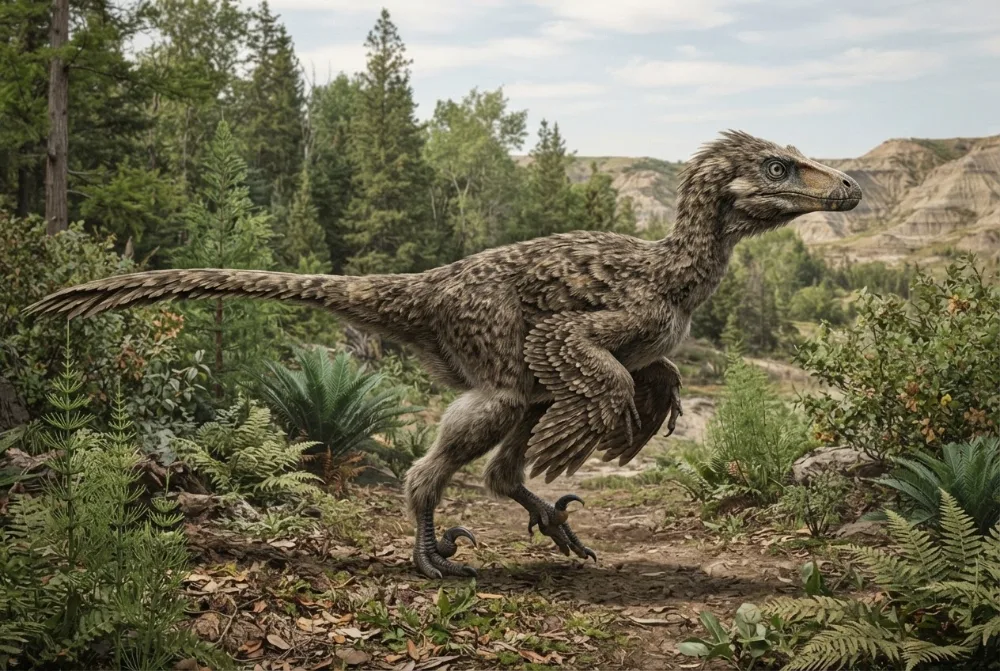
Latenivenatrix was a large, bird-like dinosaur that lived in what is now Canada. It was one of the biggest troodontids ever found, and it probably ate both plants and meat. Scientists are still debating whether it was really its own species or just a different name for another dinosaur called Stenonychosaurus.14
Ɗuum wuurii nde?
Hol no o mawni?
No juutuno?
No toowuno?
Hol no Latenivenatrix mawninoo, so fondaama bee AAN?
Hiisa tan nder browser maa. Walaa huunde danndetee walla neldetee ka nokku fuu.
How fast was it?
Anndal belɗungal
Latenivenatrix is the largest known troodontid, reaching up to 3.5 meters (11.5 feet) in length.1
Its name means 'hiding huntress' in Latin, because it was a stealthy predator.1
The first fossil of Latenivenatrix was found in 1968 by Irene Vanderloh in Alberta, Canada.1
Some scientists think Latenivenatrix might actually be the same species as Stenonychosaurus, not a separate dinosaur.1
Latenivenatrix had a special pelvis with a pubis bone that was tilted backward at a 17-degree angle.1
Naamne ɓurɗe naamneede fii Latenivenatrix
?How big was Latenivenatrix?
It was about 3 to 3.5 metres (9.8 to 11.5 ft) long, making it the largest known troodontid. Its skull was about 45 centimetres (18 in) long.1
?What did Latenivenatrix eat?
It was probably a semi-omnivore, meaning it ate both plants and meat. It was a bird-like dinosaur that likely hunted small prey and also ate plants.1
?Is Latenivenatrix a dinosaur?
Yes, it is a dinosaur. It belongs to a group of bird-like dinosaurs called troodontids.1
?When did Latenivenatrix live?
It lived about 75.5 million years ago during the Cretaceous Period. Its fossils were found in Alberta, Canada.1
?What does the name Latenivenatrix mean?
It means 'hiding huntress' in Latin, because it was a stealthy predator.3
?Could Latenivenatrix fly?
No, it could not fly. As a troodontid, it probably lost the ability to fly and was a biped that walked on two legs.1

Naamnu Rex fii Latenivenatrix
Rex jaabata ƴamle dow hello ngo'o tan. Ƴamle 10 e lewru.
Rex ko AI, o waawi waɗugo juumre. O golla ka serverji nder EU, naamne danndetaake abada. Taa winndu innde maa walla huunde goɗnde ngam maa.
Feññinoowo goonga
Fenaande: Latenivenatrix is definitely a unique dinosaur species.
Goonga: Some scientists argue that Latenivenatrix is actually a junior synonym of Stenonychosaurus, meaning it may not be a separate species.1
Ngam annduɓe dino
- Innde ganndal
- Latenivenatrix
- Inndoowo
- van der Reest and Currie 20174
- Fedde
- Raptors
- Fedde / clade
- Troodontidae4
- Fedde
- Theropoda > Troodontidae4
- Duuɓi kaaƴe
- 84 haa 72 miliyon duuɓi (Campanian)4
- Cuuɗi kaaƴe
- Dinosaur Park4
- Leyɗe
- Canada4
- Fosilji tawaaɗi
- 4 nder Paleobiology Database4
- Tawgol
- Latenivenatrix was named in 2017 by paleontologists Aaron van der Reest and Philip Currie. The type specimen was originally collected in 1968 and had been assigned to other troodontids before being recognized as a new genus.14
- Haa jooni ɓe ɗon yeddondira
- Scientists still debate whether Latenivenatrix is a valid genus or just a synonym of Stenonychosaurus.1
To haalaaji ummii
- Latenivenatrix (en.wikipedia.org)
- Two New Cretaceous Dinosaur Species Discovered in Canada | Sci.News (sci.news)
- Paleo Profile: The Hiding Hunter | Scientific American (scientificamerican.com)
- Latenivenatrix in The Paleobiology Database (CC BY 4.0): duuɓi, nokkuuje, cuuɗi kaaƴe, pecce.
Kala anndal nder ngal hello mari limre holloore iwdi mum. Si min mbaɗii juumre, yaafo min, min ko yiɗɓe dino, min wanaa jaaynde anndal. Haalan min ka hello@dinowiki.app, min moƴƴinan ɗum.
 Rex ɗon weelo! Dino Wiki, ɗum golle baaba ngam ɓiyiiko gorko mo yiɗi dinosauruuji, alaa njoɓdi, alaa ko yeeyata. Mawɓe mbaawi hokkude Rex ñaamdu ngam wallude lowre ndee heddoo e internet.Nyaamnu Rex
 Velociraptor
 Microraptor
 Deinonychus
 Asiamericana
 Richardoestesia
 Saurornitholestes
 Tyrannosaurus
 Triceratops
 Spinosaurus
 Ankylosaurus
 Parasaurolophus
 Pteranodon