
Avimimus
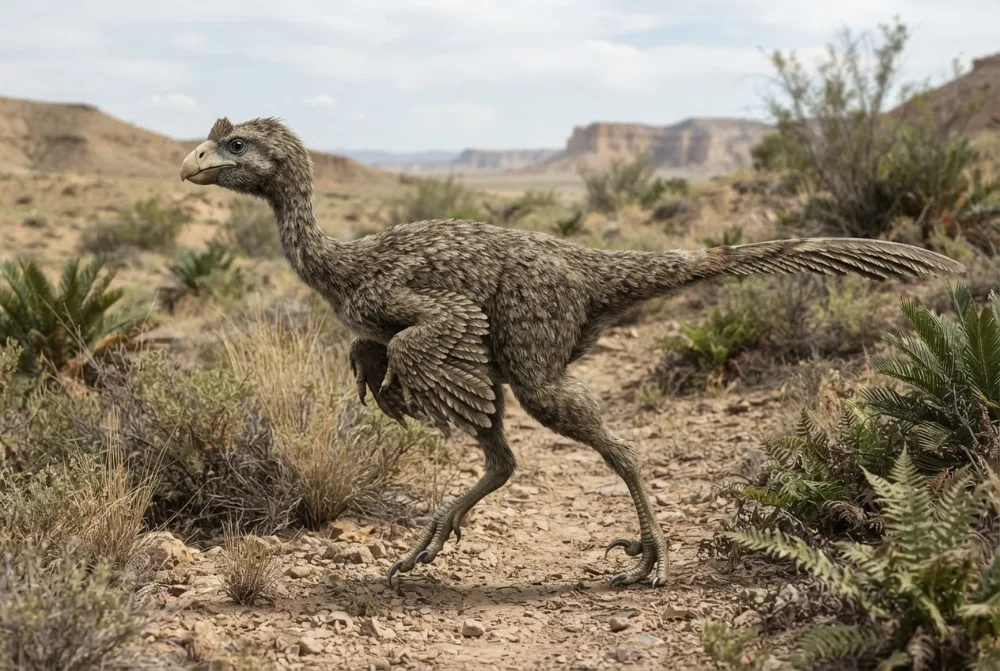
Avimimus was a small, fast-running dinosaur that looked a lot like a bird. It had a beak like a parrot and may have had feathers on its arms. Scientists think it lived in what is now Mongolia during the Late Cretaceous period.21
Ɗuum wuurii nde?
Hol no o mawni?
No juutuno?
No tedduno?
Hol no Avimimus mawninoo, so fondaama bee AAN?
Hiisa tan nder browser maa. Walaa huunde danndetee walla neldetee ka nokku fuu.
How fast was it?
Anndal belɗungal
Avimimus had a large brain and big eyes, which helped it see well and think fast.2
Its legs were very long and slender, making it a fast runner. Its shins were longer than its thighs, just like in many speedy animals today.2
The bones in its hand were fused together, just like in modern birds. This is one reason scientists think it was very bird-like.2
A fossil bonebed in Mongolia contained at least ten Avimimus individuals together. This suggests they lived in groups, maybe for safety or to find mates.2
Avimimus had a beak with no teeth, but some later fossils show tiny teeth in the front of the upper jaw. Scientists are still studying this.2
When Avimimus was first discovered, scientists thought it had no tail. Later finds proved it did have a tail, just like other dinosaurs.2
Naamne ɓurɗe naamneede fii Avimimus
?Did Avimimus have feathers?
Yes, most scientists now agree Avimimus had feathers. Quill knobs on its arm bones suggest feathers were attached there.24
?What did Avimimus eat?
It probably ate both plants and small animals, making it an omnivore. Its beak had no teeth, though some fossils show tiny front teeth.21
?How fast could Avimimus run?
It was a very fast runner, with long legs and shins longer than its thighs. One source compares its speed to an ostrich, which can reach 70 km/h.24
?When did Avimimus live?
It lived during the Late Cretaceous period, about 80 to 75 million years ago.14
?Is Avimimus a bird?
No, Avimimus is a dinosaur, not a bird. It belonged to a group of bird-like dinosaurs called oviraptorosaurs.2
Naamnu Rex fii Avimimus
Rex jaabata ƴamle dow hello ngo'o tan. Ƴamle 10 e lewru.
Rex ko AI, o waawi waɗugo juumre. O golla ka serverji nder EU, naamne danndetaake abada. Taa winndu innde maa walla huunde goɗnde ngam maa.
Feññinoowo goonga
Fenaande: Avimimus could fly.
Goonga: Some scientists once thought Avimimus could fly because it had bumps on its arm bones that might have held feathers. But most now agree it could not fly and was a fast runner instead.2
Ngam annduɓe dino
- Innde ganndal
- Avimimus
- Inndoowo
- Kurzanov 19815
- Fedde
- Dinosauri kaawniiɗi marɗi leeɓi
- Fedde / clade
- Oviraptorosauria5
- Fedde
- Theropoda > Oviraptorosauria5
- Duuɓi kaaƴe
- 84 haa 66 miliyon duuɓi (Campanian / Maastrichtian)5
- Cuuɗi kaaƴe
- Nemegt, Baruungoyot, Dinosaur Park5
- Leyɗe
- Mongolia, Canada5
- Fosilji tawaaɗi
- 8 nder Paleobiology Database5
- Tawgol
- Avimimus was named by Russian paleontologist Sergei Kurzanov in 1981. He found the fossils in Mongolia and thought they came from the Djadokhta Formation, but later scientists think they actually came from the Nemegt Formation.25
- Haa jooni ɓe ɗon yeddondira
- Scientists are not sure what Avimimus ate. It might have been an herbivore, an insectivore, or an omnivore. The beak and possible tiny teeth give clues, but no one knows for sure.2
To haalaaji ummii
- Avimimus | Natural History Museum (nhm.ac.uk)
- Avimimus (en.wikipedia.org)
- Avimimus Kurzanov 1981 - Encyclopedia of Life (eol.org)
- Avimimus - ZoomDinosaurs.com (enchantedlearning.com)
- Avimimus in The Paleobiology Database (CC BY 4.0): duuɓi, nokkuuje, cuuɗi kaaƴe, pecce.
Kala anndal nder ngal hello mari limre holloore iwdi mum. Si min mbaɗii juumre, yaafo min, min ko yiɗɓe dino, min wanaa jaaynde anndal. Haalan min ka hello@dinowiki.app, min moƴƴinan ɗum.
 Rex ɗon weelo! Dino Wiki, ɗum golle baaba ngam ɓiyiiko gorko mo yiɗi dinosauruuji, alaa njoɓdi, alaa ko yeeyata. Mawɓe mbaawi hokkude Rex ñaamdu ngam wallude lowre ndee heddoo e internet.Nyaamnu Rex
 Therizinosaurus
 Oviraptor
 Chirostenotes
 Citipes
 Leptorhynchos
 Caenagnathus
 Tyrannosaurus
 Triceratops
 Velociraptor
 Spinosaurus
 Ankylosaurus
 Parasaurolophus