
Gallimimus
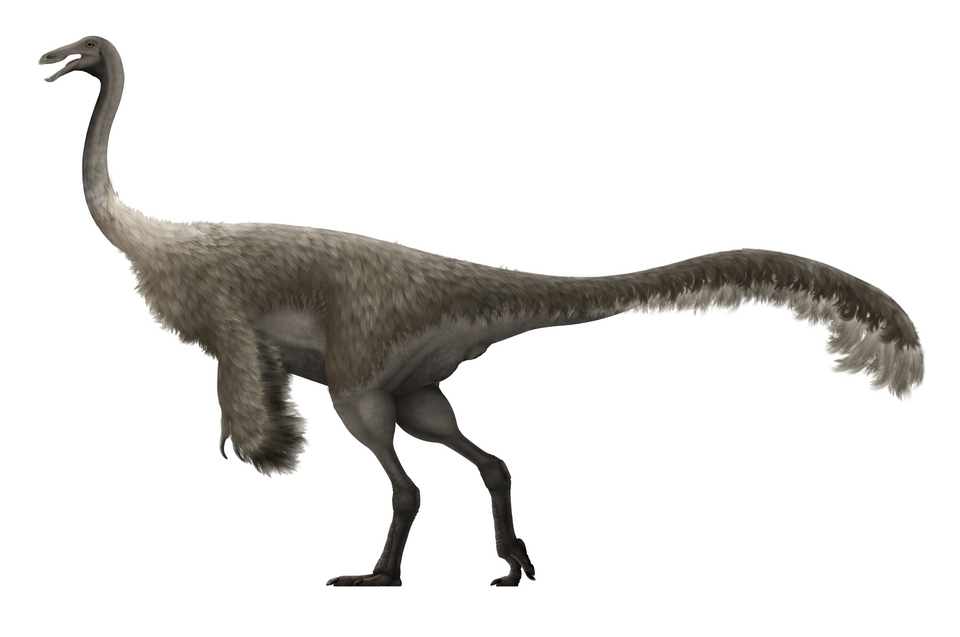
Gallimimus was a fast, ostrich-like dinosaur that lived in what is now Mongolia. It had a small head, big eyes, and a long neck, and it could run up to 56 kilometers per hour (35 miles per hour) to escape predators.1
When did it live?
How big was it?
Fun facts
Gallimimus is the largest known ornithomimid, or ostrich dinosaur. Adults were about 6 meters (20 feet) long and weighed up to 490 kilograms (1,080 pounds).1
Its name means 'chicken mimic' because the bones in its neck look like those of chickens and other galliform birds.1
Gallimimus could run at speeds of 42 to 56 kilometers per hour (29 to 34 miles per hour), making it one of the fastest dinosaurs.1
Scientists think Gallimimus may have had feathers, like its relative Ornithomimus.1
Several Gallimimus skeletons were found together in a bone bed, which suggests they might have lived in groups.1
Gallimimus appeared in the movie Jurassic Park, running across a field in a famous scene that helped show dinosaurs as bird-like animals.1
Myth buster
Myth: Gallimimus used its beak to filter small animals from water, like a flamingo.
Truth: The ridges in its beak were more like those of plant-eating animals. Scientists now think Gallimimus was a herbivore that ate tough plants, not a filter-feeder.1
For dino experts
- Scientific name
- Gallimimus
- Named by
- Osmólska et al. 19722
- Group
- Ostrich dinos
- Family / clade
- Ornithomimidae2
- Classification
- Theropoda > Ornithomimosauria2
- Age of the rocks
- 94 to 66 million years (Turonian to Maastrichtian)2
- Rock formations
- Nemegt, Baruungoyot, Bissekty2
- Countries
- Mongolia, Uzbekistan2
- Fossil records
- 30 in the Paleobiology Database2
- Discovery
- Polish and Mongolian scientists found several Gallimimus skeletons in the Gobi Desert during the 1960s. The dinosaur was named Gallimimus bullatus in 1972 by Halszka Osmólska, Ewa Roniewicz, and Rinchen Barsbold.12
- Still debated
- Scientists still debate what Gallimimus ate. Some think it was an omnivore that ate small animals and plants, while others believe it was mainly a plant-eater.1
Where the facts come from
- Gallimimus (en.wikipedia.org)
- Gallimimus in The Paleobiology Database (CC BY 4.0): age, places, rock formations, classification.
Every fact on this page has a number that points to its source. If we got something wrong, sorry, we are dino fans, not a science journal. Tell us at hello@dinowiki.app and we will fix it.
 Rex is hungry! Dino Wiki is free with no ads. Grown-ups can feed Rex a snack to keep it that way.Feed Rex
 Ornithomimus
 Struthiomimus
 Deinocheirus
 Dromiceiomimus
 Archaeornithomimus
 Anserimimus
 Triceratops
 Velociraptor
 Spinosaurus
 Ankylosaurus
 Parasaurolophus