
Cryptoclidus
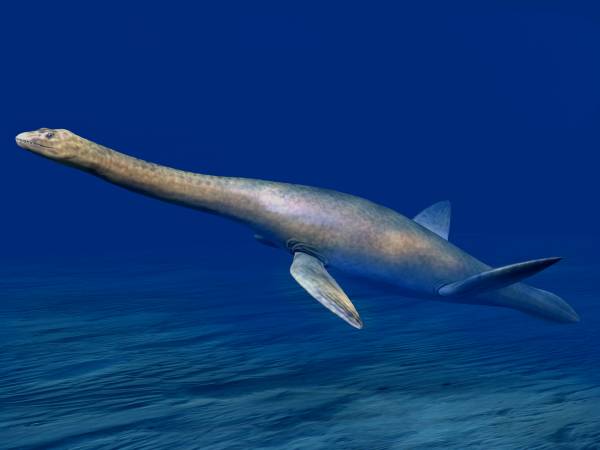
Cryptoclidus was a medium-sized plesiosaur that swam in warm seas during the Middle and Late Jurassic. It had a small head, a long neck, and four flippers. It probably ate soft animals like squid and small fish.1
When did it live?
How big was it?
Fun facts
The name Cryptoclidus means 'hidden collarbone' because its collarbones are tiny and hidden in the shoulder area.1
Fossils of Cryptoclidus have been found in the Oxford Clay of Cambridgeshire, England, and in the Kimmeridge Clay of France.1
The type species was first called Plesiosaurus eurymerus, which means 'wide thigh bone', because scientists mistook a front flipper bone for a back leg bone.1
Cryptoclidus had a small, fragile skull and teeth that could not handle tough prey, so it ate only soft animals.1
Scientists think Cryptoclidus used its long, intermeshing teeth to strain small animals from the water or sift through mud.1
The size and shape of its nostrils suggest Cryptoclidus could smell chemicals in seawater, helping it find food.1
Complete skeletons of Cryptoclidus have been found, including some that are nearly entirely preserved, showing both adults and juveniles.1
Myth buster
Myth: Some people think Cryptoclidus was a dinosaur.
Truth: Cryptoclidus was a plesiosaur, a marine reptile that lived in the sea, not a dinosaur.1
For dino experts
- Scientific name
- Cryptoclidus
- Named by
- (Seeley 1892)2
- Group
- Plesiosaurs
- Family / clade
- Cryptoclididae2
- Classification
- Plesiosauria > Sauropterygia2
- Age of the rocks
- 165 to 143 million years (Callovian to Tithonian)2
- Rock formations
- Oxford Clay, Jagua, Kimmeridge Clay2
- Countries
- United Kingdom, Cuba, Argentina, France2
- Fossil records
- 17 in the Paleobiology Database2
- Also known as
- Apractocleidus (older names now counted as the same animal)2
- Discovery
- The first fossils were described in 1871 by John Phillips as Plesiosaurus eurymerus. Harry Govier Seeley renamed it Cryptoclidus in 1892.12
- Still debated
- Scientists are not sure whether Cryptoclidus caught prey by swimming fast or by ambushing it, because its skeleton was not built for speed.1
Where the facts come from
- Cryptoclidus (en.wikipedia.org)
- Cryptoclidus in The Paleobiology Database (CC BY 4.0): age, places, rock formations, classification.
Every fact on this page has a number that points to its source. If we got something wrong, sorry, we are dino fans, not a science journal. Tell us at hello@dinowiki.app and we will fix it.
 Rex is hungry! Dino Wiki is free with no ads. Grown-ups can feed Rex a snack to keep it that way.Feed Rex
 Elasmosaurus
 Pliosaurus
 Plesiosaurus
 Cimoliasaurus
 Colymbosaurus
 Trinacromerum
 Brachiosaurus
 Diplodocus
 Allosaurus
 Brontosaurus
 Compsognathus
 Camarasaurus