
Tatankaceratops
Tatankaceratops was a small, horned dinosaur that lived about 66 million years ago. It had a short, slender brow horn and a long nose horn, like a tiny Triceratops. Scientists are not sure if it was a real new kind of dinosaur or just a young Triceratops with a strange growth problem.1
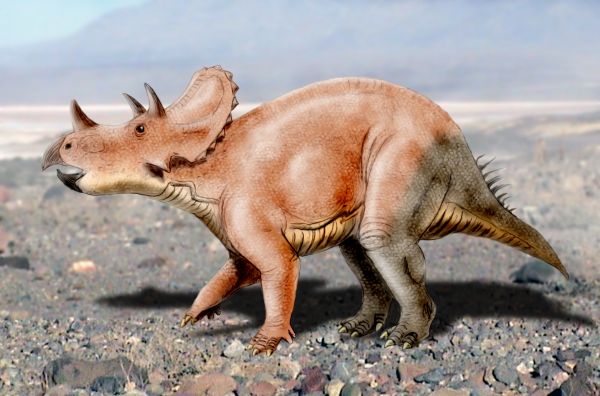
When did it live?
Fun facts
Tatankaceratops is known from only one partial skull, which is kept at the Black Hills Institute in South Dakota.1
Its name means 'bison horned face' because its nose horn reminded scientists of a bison's horn.1
The skull of Tatankaceratops has a strange mix of features: some parts look like a young dinosaur, but other parts are fused and worn like an old adult.1
Some scientists think Tatankaceratops might be a dwarf species of Triceratops, or just a Triceratops that had a disorder that stopped it from growing normally.1
Tatankaceratops lived at the very end of the age of dinosaurs, about 66 million years ago, in the same time and place as Triceratops.1
Myth buster
Myth: Tatankaceratops is definitely a new, separate dinosaur genus.
Truth: Many scientists now think Tatankaceratops is just a young Triceratops or a Triceratops with a growth disorder, not a valid genus.1
For dino experts
- Scientific name
- Tatankaceratops
- Named by
- Ott and Larson 20102
- Group
- Horned dinos
- Family / clade
- Ceratopsidae2
- Classification
- Ornithischia > Ceratopsia > Ceratopsidae2
- Age of the rocks
- 84 to 66 million years (Campanian to Maastrichtian)2
- Rock formations
- Hell Creek2
- Countries
- USA2
- Fossil records
- 166 in the Paleobiology Database2
- Discovery
- Tatankaceratops was named by Christopher J. Ott and Peter L. Larson in 2010, based on a partial skull found in the Hell Creek Formation of South Dakota.1
- Still debated
- Scientists still debate whether Tatankaceratops is a valid genus, a dwarf species of Triceratops, or just a Triceratops with a developmental disorder.1
Where the facts come from
- Tatankaceratops (en.wikipedia.org)
- Tatankaceratops in The Paleobiology Database (CC BY 4.0): age, places, rock formations, classification.
Every fact on this page has a number that points to its source. If we got something wrong, sorry, we are dino fans, not a science journal. Tell us at hello@dinowiki.app and we will fix it.
 Rex is hungry! Dino Wiki is free with no ads. Grown-ups can feed Rex a snack to keep it that way.Feed Rex
 Triceratops
 Protoceratops
 Ojoceratops
 Psittacosaurus
 Centrosaurus
 Chasmosaurus
 Velociraptor
 Spinosaurus
 Ankylosaurus
 Parasaurolophus
 Pteranodon